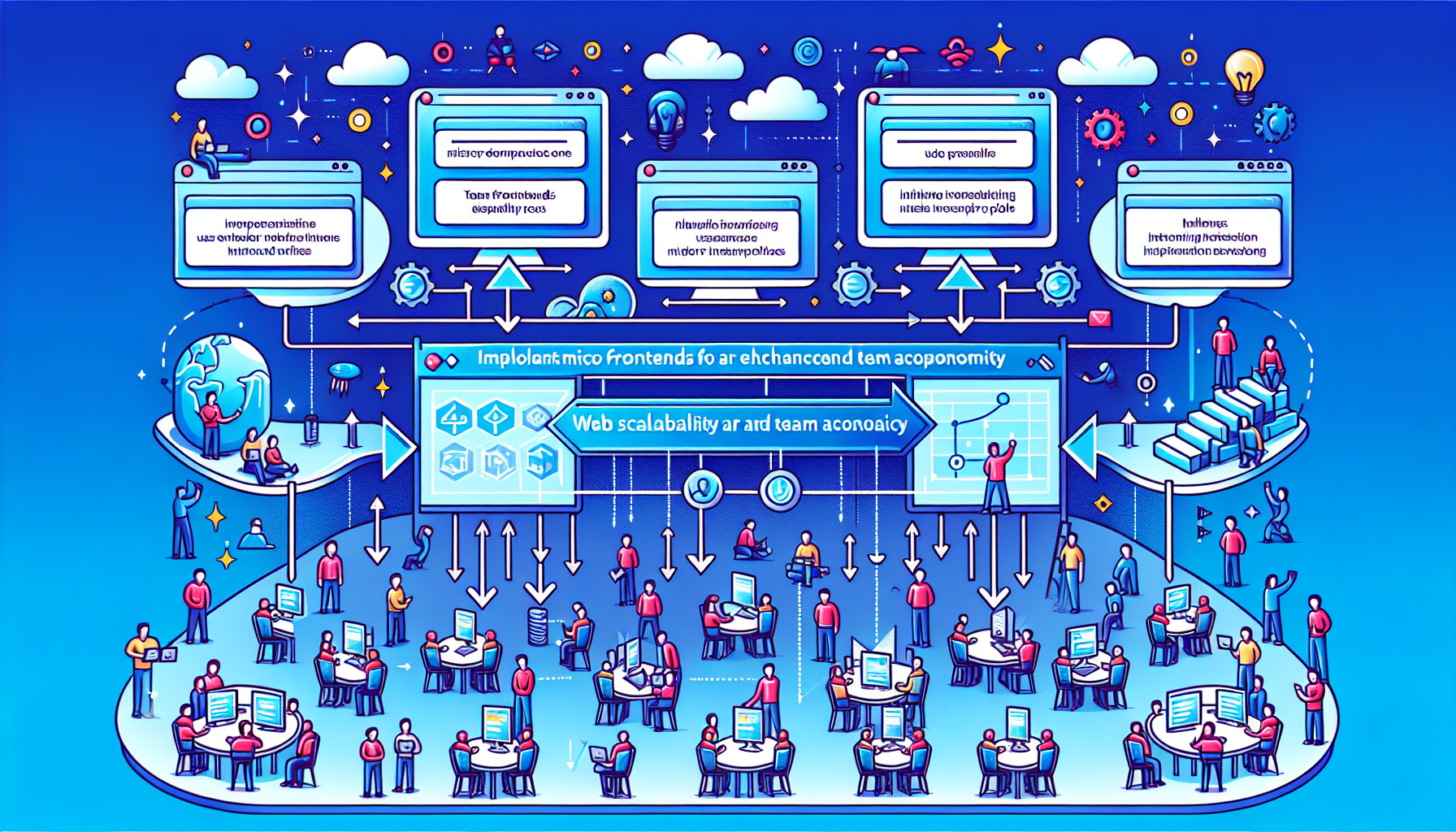
Implementing Micro Frontends for Enhanced Web Scalability and Team Autonomy
Introduction
Micro frontends have emerged as a popular architectural style that extends the concepts of microservices to the frontend development world. This approach enables different frontend teams to work independently on distinct features of a web application, improving scalability and team autonomy. In this blog post, we will explore the basics of micro frontends, discuss their benefits, and provide a step-by-step guide on how to implement them.
What are Micro Frontends?
Definition
Micro frontends are a design approach where the frontend of a web application is composed of multiple, smaller applications. Each of these ‘mini-apps’ can be developed, tested, and deployed independently by different teams, focusing on specific business functionalities.
Key Characteristics
- Decoupled Codebases: Each micro frontend has its own codebase, allowing teams to work in isolation from each other.
- Technology Agnostic: Teams can choose their technology stacks without affecting other parts of the frontend.
- Independent Deployment: Micro frontends can be deployed independently, which allows for faster updates and better handling of specific features without impacting the entire application.
- Scoped CSS and JS: To avoid clashes, each micro frontend uses scoped or namespaced CSS and JavaScript.
Benefits of Using Micro Frontends
- Enhanced Scalability: Allows handling more complex features and user interfaces by distributing the workload across multiple teams.
- Increased Team Autonomy: Teams can operate more independently, making decisions that are best for their specific components without needing large-scale consensus.
- Improved Maintainability: Easier to update and maintain smaller, independent codebases compared to a large monolithic frontend.
- Flexible and Incremental Upgrades: New technologies and frameworks can be tested in one micro frontend without the risk of affecting the entire application.
Implementing Micro Frontends
Step 1: Define Responsibilities
Each micro frontend should have a well-defined responsibility, closely related to a specific business domain or user journey.
Step 2: Choose a Hosting Approach
There are several ways to serve micro frontends to users:
- Build Time Integration: Micro frontends are combined at build time into a single bundled application.
- Server-Side Composition: Server dynamically combines micro frontends into a single HTML file before serving it to clients.
- Client-Side Composition: Micro frontends are loaded independently at the client-side, usually managed by a framework or library like Single-SPA.
Step 3: Set Up Communication
Inter-micro frontend communication is crucial, especially when they need to interact or share data:
// Publishing an event
window.dispatchEvent(new CustomEvent('cartUpdated', { detail: { items: 3 } }));

// Subscribing to an event
window.addEventListener('cartUpdated', function(event) {
  console.log('Cart items:', event.detail.items);
});
Step 4: Implement Independent Deployment
Each micro frontend should have its own CI/CD pipeline allowing it to be built, tested, and deployed independently.
Conclusion
Micro frontends offer a promising solution to many of the scalability issues faced by modern web applications while enhancing team autonomy. By following the steps outlined in this guide, organizations can start leveraging the benefits of this innovative architecture to build more robust and user-centered web applications.